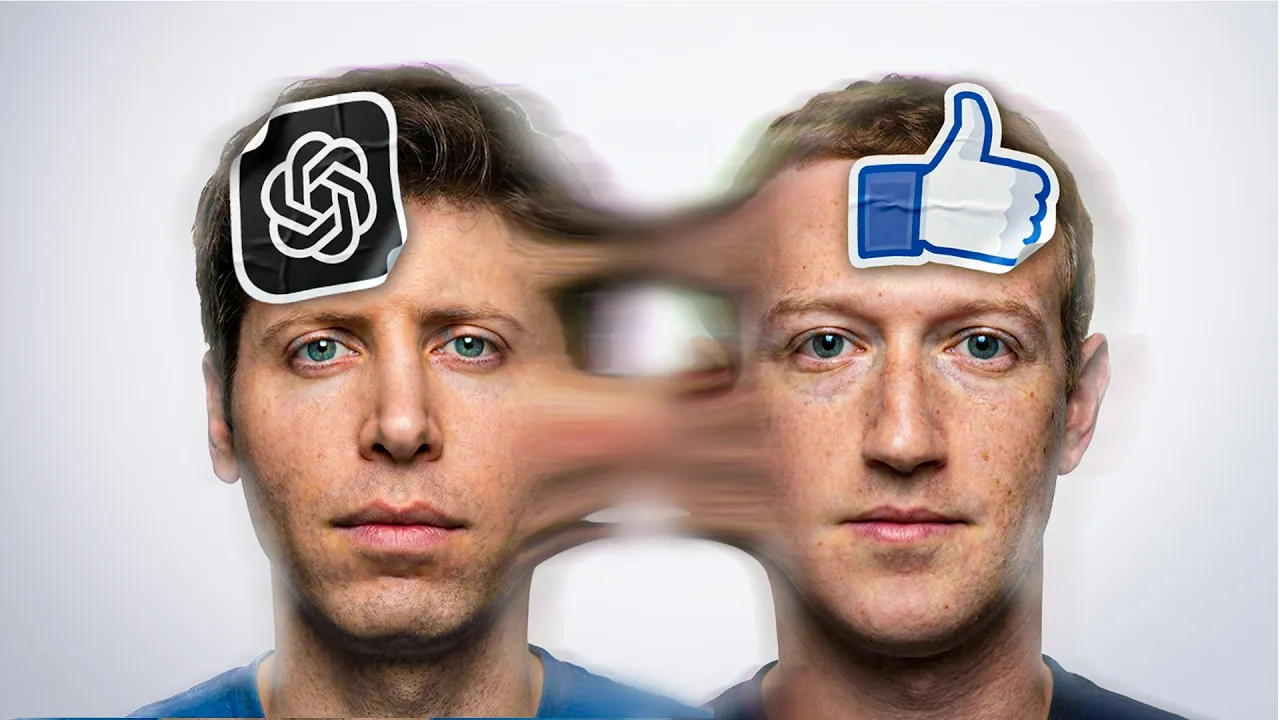
Creator: Enrico Tartarotti · Published: 2025-12-14 · Length: 16:18 · Watch on YouTube
Why did the fastest product in history to reach 100 million users start as an accident? Why is OpenAI spending billions on a hardware company instead of better AI? What do memory features, voice mode, and group chats have to do with search? (from the video description)
"Let's Google it" became "let's ask ChatGPT" in a few years, and ChatGPT looks like the next Google. Enrico argues it's quietly turning into the next Facebook instead, for three reasons that go deeper than adding ads: the economics of AI answers, a product design built for engagement rather than quick answers, and the fight to own distribution. Sponsored by Hostinger (VPS hosting for the n8n automation tool). Written and produced by Enrico Tartarotti; edited by Seequence Studio.
Summary written from the auto-generated captions, the video description and the creator's chapter markers. Some cost comparisons in the video are shown as on-screen graphics whose numbers aren't spoken, so they aren't reproduced here.
1) Detailed outline
[0:00] The shift from Google to AI
- Settling an argument with friends used to mean "let's Google it"; in the last few years it became "let's ask ChatGPT." A habit Google spent decades building changed almost overnight.
- ChatGPT now handles billions of queries a day, has about 800 million weekly users, and became the fastest-growing product in history. It looks like the next Google, but Enrico says OpenAI is really building the next Facebook, and that this is about more than plastering it with ads.
[0:45] The accidental consumer product
- Consumer brands like Google, Spotify, Nutella, Netflix and Coca-Cola have names designed to work for billions of people. ChatGPT stands for "generative pre-trained transformer," the kind of name an engineer gives an internal test project, because that's what it was.
- When it launched in November 2022 it was the fastest product ever to reach 100 million users, set off an industry-wide scramble to build large language models, and had Nvidia selling GPUs to everyone.
- OpenAI never expected ChatGPT to be the product. Its business was the model running on servers, sold to other companies (boring enterprise); ChatGPT was a "look what our model can do" demo. When it exploded, OpenAI ran with it, and Google went into code red at having a real competitor for the first time.
[2:23] ChatGPT's true ambition
- OpenAI made the expected Google-style moves: ChatGPT Search and a web browser.
- At the same time it did stranger things: a memory feature that remembers your birthday, job or dog's name; a voice mode that laughs like a friend; a $200-a-month Pro subscription it reportedly loses money on; a $6.5 billion deal for a hardware company with no product, run by Jony Ive; talk of ads; and a policy change allowing adult content for verified users.
- None of that is trying to be the next Google. Enrico gives three reasons ChatGPT may be forced into becoming something else.
[3:42] Reason 1: the high cost of AI search
- On screen he compares the cost of delivering one Google search (a list of blue links) with the average cost of a ChatGPT interaction. ChatGPT's economics are "broken": at Google's volume of about 8.5 billion searches a day, ChatGPT's costs would burn through its entire valuation in months.
- Google could fund side quests like Waymo and Google Maps because it found one of the best business models ever: ads on searches.
- Google had to build its infrastructure from scratch. Larry Page and Sergey Brin built their first server from ten 4 GB hard drives in a cabinet made of Lego bricks, because it was cheap and easy to modify; it's on display at Stanford. That scrappy mindset led Google to buy 15,000 cheap PCs instead of supercomputers and write its own software to run them.
- Today Google has over 2 million custom servers, its own TPUs (AI chips) and undersea cables: the whole stack. OpenAI mostly runs on Microsoft data centers because of Microsoft's investment, and pays for it. "You cannot out-Google Google when you're paying rent to someone else."
- Free search also trained billions of people to expect the internet to be free: email, maps and browsers, all subsidized by search ads. Enrico's non-tech friends think he's insane for paying $200 a month for Claude Max or $20 for Gemini, and few regular ChatGPT users pay the $20 subscription. OpenAI is playing Google's game of free now, convert later.
[5:30] Engaging vs. searching
- The two products feel completely different. Google is built to get you in and out fast (it even tells you how fast it loaded), makes money in that brief moment, and the interaction costs it almost nothing.
- ChatGPT is built for you to stay. The chat interface makes everything a conversation, and the main action isn't clicking a link out but asking something else, adding a file and going deeper.
- A product that keeps you engaged as long as possible and is built on other people's content isn't Google; it's Facebook, Instagram or YouTube. ChatGPT accidentally built Facebook's engagement model without Facebook's monetization engine.
- Bleeding money on billions of non-paying users, OpenAI turns to ads: code hinting at ads has been found in the Android app, and early testers' ad sightings have leaked. Google and Meta both make money on ads but in very different ways, which sets up reason two.
[7:48] Sponsor: Hostinger VPS for n8n
- Enrico shows n8n workflows he built for the channel: one gathers top tech news from sources like Axios, Hacker News and blogs into a digest sent to his Notion database; another tracks top new tech videos and which titles and thumbnails are working, the starting point for this video's research and packaging.
- n8n requires paying for your own server; Hostinger's virtual private server runs it at up to four times cheaper than n8n's cloud version, with a one-click pre-installed n8n template. The KVM 2 plan offers self-hosting, unlimited workflows and concurrent executions, with data on your own server. Code ENRICO gives a discount on yearly plans.
[9:18] Reason 2: the context graph
- When a Google result is wrong, you blame the website (and its GDPR cookie pop-ups). When ChatGPT is wrong, you blame ChatGPT, and AI hallucinations are almost a meme.
- Google is a messenger: it shows you links and you choose; even with AI Overviews, most of the page is the familiar results. ChatGPT feels like the author: in its responses the answer takes most of the space and sources very little, the reverse of Google.
- So instead of learning about the world, ChatGPT learns about the user and becomes a companion: memory of past conversations, tailoring to your tastes and quirks, almost a friend. Engagement, hyper-personalization and longer sessions are textbook social-media strategy, and the social-media echo chamber becomes ChatGPT starting every reply with "you're right."
- Perplexity tries to be more like Google, focused strictly on search. ChatGPT goes deeper: Facebook built its empire on the social graph (who you know); OpenAI is building what Enrico calls a context graph (who you are), including your work history, writing style, how you phrase things when frustrated, and what you told it about your relationship at 2 a.m.
[11:21] Reason 3: owning distribution
- Chrome is the best example of owning distribution. Google wasn't the default search engine; you had to go to Google first, and with most people on Internet Explorer, Google was at Microsoft's mercy. Building a great browser was how Google took control of how people reach it, "owning the thing that our product is inside of." The product manager behind that idea is now Google's CEO. Android was the same strategic move.
- That's why the browser wars are back: OpenAI's Atlas, Perplexity's Comet, and The Browser Company's Dia. ChatGPT and every other AI model is still just an app or website you have to open yourself; it isn't a default unless a browser or device makes it one.
- Changing the habits of billions of mainstream users is the hardest thing in tech, so ChatGPT's real asset isn't data centers or the best model. It's that "ChatGPT" has become a genericized trademark, like Band-Aid for adhesive bandages or Nutella for hazelnut spread: "AI? Oh, it's ChatGPT." OpenAI got that by accident, and it won't last forever.
[13:24] Crossroads for OpenAI
- To win long-term, OpenAI has to take control of distribution as Google did, but unlike Google in 2005 it doesn't have a decade; it's burning hundreds of millions of dollars a month.
- That explains moves that look weird: Sora, an app for AI-generated videos built for creating and sharing rather than searching; group chats with ChatGPT and friends, the way iMessage and WhatsApp are entry points today; custom GPTs and the GPT Store. These are social-network features. Facebook never tried to be your home page; it became your habit, and ChatGPT is doing the same.
- The browser and the $6.5 billion Jony Ive hardware company (Ive designed the iPhone, iPod and Mac) are distribution plays, but breakthrough hardware is much harder than an AI model. Facebook tried with the Facebook phone; Meta still tries with the Meta Quest and its "dubiously successful" metaverse, and now Ray-Ban Meta glasses, which are a genuinely good product seeing some success. Meta is worth over a trillion dollars and still doesn't own distribution.
- Product strategy means fighting economics, psychology and entrenched distribution at once. OpenAI is at a crossroads: double down on being a research lab with the best AI, or chase distribution and become the next Meta. It recently declared its own code red over how good Google's Gemini has become, pausing many side initiatives.
- Teaser for the next video: why we rage at a $2 Netflix price increase but rush to buy a $1,600 iPhone every year, and how the price of tech got broken.
2) Things mentioned
OpenAI products and moves
- ChatGPT (launched November 2022; about 800 million weekly users), ChatGPT Search, memory, voice mode
- ChatGPT Pro ($200 a month) and the $20 Plus subscription
- ChatGPT ads (code in the Android app, leaked tests) and the adult-content policy for verified users
- Atlas browser, Sora app, group chats, custom GPTs and the GPT Store
- The $6.5 billion acquisition of Jony Ive's hardware company
- Google Search and its ad business (about 8.5 billion searches a day), AI Overviews
- Chrome, Android, Google Maps, Waymo, Gemini ($20 a month)
- The Lego-brick server at Stanford, 15,000 cheap PCs, 2 million custom servers, TPUs, undersea cables
Other AI and browser competitors
- Claude Max ($200 a month)
- Perplexity and its Comet browser
- The Browser Company and Dia
- Internet Explorer (Microsoft's old browser dominance)
- Microsoft data centers (OpenAI's infrastructure) and Nvidia GPUs
Social platforms and hardware
- Facebook (social graph, engagement model), Instagram, YouTube, iMessage, WhatsApp
- Facebook phone, Meta Quest and the metaverse, Ray-Ban Meta glasses
- iPhone ($1,600), iPod and Mac (Jony Ive designs)
- Netflix (the $2 price-increase example)
Sponsor and tools
- Hostinger VPS (KVM 2 plan, one-click n8n template, code ENRICO)
- n8n automation; Axios, Hacker News and Notion in Enrico's workflows
- Flask (Enrico's product, linked in the description)
Business and design concepts
- Accidental consumer products and engineer-named brands
- Per-query AI compute cost versus search
- Owning the full infrastructure stack versus renting
- Free-internet expectations subsidized by search ads
- "Get in and get out" design versus engagement-maximizing design
- Messenger versus author, and who gets blamed for wrong answers
- Social graph versus context graph
- Owning distribution and defaults; the new browser wars
- Genericized trademarks (Band-Aid, Nutella, ChatGPT)
- Habit-forming entry points versus home pages
3) Biographies
Enrico Tartarotti
Italian-born YouTuber, designer and entrepreneur whose channel goes "behind the scenes of the design and psychology and stories behind the tech you use everyday." He builds Flask, a video-collaboration tool, and writes and produces his videos, which are edited by Seequence Studio.
Larry Page
Google co-founder and former CEO. With Sergey Brin he built Google's first server out of 4 GB hard drives in a Lego-brick cabinet while at Stanford, the start of the cheap-hardware philosophy Enrico describes.
Sergey Brin
Google co-founder who met Larry Page at Stanford and co-built the Lego-brick server and early search engine.
Jony Ive
British designer who led Apple design on the iPod, iPhone and Mac, then left to found his own studio. Enrico cites OpenAI's $6.5 billion deal for Ive's hardware company, which had no real product yet, as a distribution play.
Google's CEO (the Chrome product manager)
Enrico doesn't name him, but the product manager who championed Chrome and later became Google's CEO is Sundar Pichai, who led Chrome and Android before becoming CEO of Google in 2015.