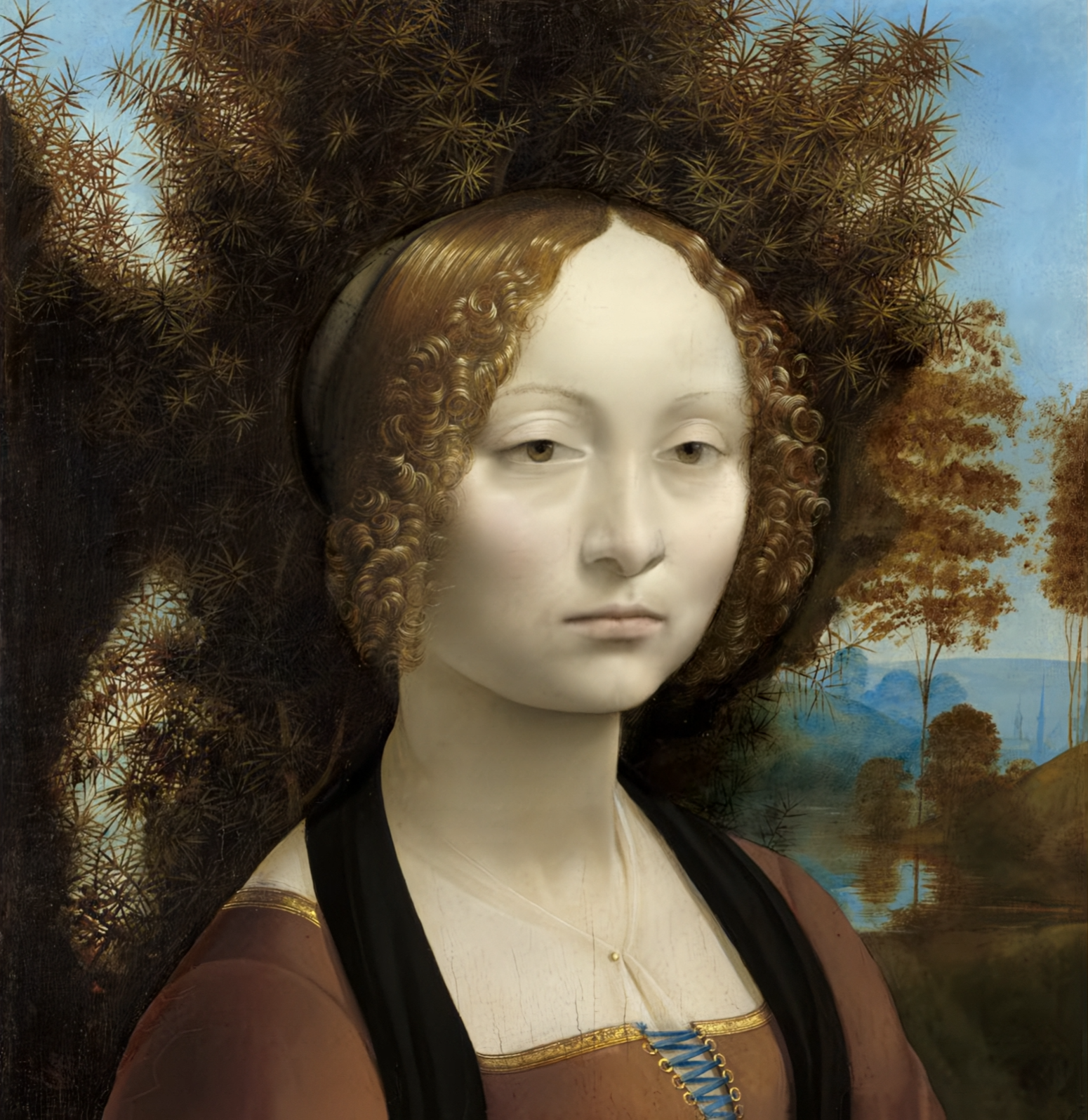
This is the first known female portrait painted by Leonardo da Vinci. The woman depicted is traditionally identified as Ginevra de’ Benci, but the mystery truly begins when we look at the reverse of the painting.
On the back, there is a symbol and a Latin phrase that continue to fuel debate among art historians about the true meaning of this work. In addition, it has recently been discovered that traces of Leonardo’s own fingerprints are still preserved on the painting.
What secrets does this painting hide?
► Shop "Portrait of Ginevra de' Benci" (c. 1474-78) at - https://www.inspiraggio.com/products/...
► Shop Art Prints & Canvas at - https://www.inspiraggio.com/collectio...
► Shop Fine Art Phone Cases at - https://www.inspiraggio.com/collectio...
→ Follow us on Instagram: / inspiraggio
→ Contact: hello@inspiraggio.com
0:00 Introduction
0:52 Who Was Ginevra de’ Benci?
2:37 Analysis
6:36 The Enigma on the Back of the Painting
9:12 Mystery Solved?
Copyright Disclaimer under section 107 of the Copyright Act of 1976, allowance is made for “fair use” for purposes such as criticism, comment, news reporting, teaching, scholarship, education, and research. Fair use is a use permitted by copyright statute that might otherwise be infringing.
Painting
The video is a structured visual essay about Leonardo da Vinci’s portrait of Ginevra de’ Benci, moving from formal analysis to the question of who commissioned it, with a final argument for Bernardo Bembo as the likely patron.youtube
High-level structure
-
Introduction: Presenting the painting, its uniqueness (first female portrait by Leonardo, only Leonardo in the U.S.), and the mystery of the reverse side and fingerprints.youtube
-
Section 1 – Who was Ginevra de’ Benci?: Brief biography, social context in Florence, and Leonardo’s situation when he painted her.youtube
-
Section 2 – Analysis of the front: Composition, pose, light, landscape, aerial perspective, symbolic juniper, and fingerprints/sfumato.youtube
-
Section 3 – The back of the painting: Emblem with juniper, laurel, palm, and the Latin motto; symbolic meanings unpacked.youtube
-
Section 4 – Who commissioned it?: Marriage hypothesis vs. Bembo hypothesis, including technical evidence (infrared study, motto change).youtube
-
Closing: Admits uncertainty about the facts and invites viewers to choose between competing hypotheses and comment.youtube
Detailed outline of the video
Introduction (0:00–0:52)
-
Identifies the painting as a late 15th‑century portrait of the young Florentine noblewoman Ginevra de’ Benci, traditionally accepted as the sitter.youtube
-
Notes it is Leonardo’s first female portrait and the only painting by him preserved in the United States.youtube
-
Introduces the “mystery”: an enigmatic reverse side and the presence of Leonardo’s fingerprints, which raise questions about meaning, patron, and what the painting reveals about his genius.youtube
Ginevra and Leonardo in Florence (0:52–2:37)
-
States that Ginevra belonged to a well‑to‑do Florentine family living near the Ponte Vecchio, one of Florence’s landmark bridges over the Arno.youtube
-
Notes she was about sixteen when painted and famed in the city for beauty and virtues, inspiring poems, praises, and sonnets.youtube
-
Places Leonardo in Florence at the same time, around age twenty‑one, working in Verrocchio’s workshop and still forging his artistic identity when he received the commission c. 1474.youtube
Formal and technical analysis of the front (2:37–6:36)
-
Describes Leonardo’s delicate portrayal:
-
Pale skin as a Renaissance noble ideal, modeled by clear natural light.
-
Slightly turned shoulders, nearly facing the viewer, breaking with the rigid Italian profile tradition in women’s portraits.youtube
-
-
Explains that this three‑quarter pose, developed earlier in Northern Europe, allows a deeper psychological reading by revealing both eyes and full mouth; the narrator compares this to Leonardo’s later Lady with an Ermine (mentioned but not analyzed here).youtube
-
Interprets her expression as “melancholic” and introspective, emphasizing the sense of encountering a real, psychologically legible person rather than a distant profile.youtube
-
Analyzes the setting:
-
Focuses on the juniper backdrop:
-
Discusses fingerprints and sfumato:
-
Mentions several fingerprints in the juniper area believed to be Leonardo’s.
-
Explains that he used fingers to soften paint and blur transitions, showing early interest in sfumato—soft contours that fade like smoke rather than sharp lines—anticipating his mature style.youtube
-
Marriage context and traditional patron theory (6:36–9:12)
-
Raises the core question: why was the portrait painted, who commissioned it, and for what purpose?youtube
-
Introduces Ginevra’s marriage:
-
Explains that for a long time scholars thought the portrait commemorated this marriage, which fits the broader Renaissance pattern where portraits of young women marked engagements or marriages as status displays.youtube
-
Describes the social function of such portraits: women as symbols of status, wealth, and lineage, with images serving as public declarations for key life events.youtube
-
Says this interpretation weakens when the painting’s reverse is examined, where a fully developed emblematic composition suggests a different story.youtube
The emblem on the back and Bembo’s role (9:12–end)
-
Describes the reverse:
- Central juniper branch (again linking to Ginevra) flanked by laurel on the left and palm on the right, with a band carrying the Latin motto “Virtutem forma decorat.”youtube
-
Unpacks symbolism:
-
Laurel: ancient emblem of poets and intellectuals, associated with writers and humanists, here pointing to Ginevra’s literary and intellectual qualities.youtube
-
Palm: traditional symbol of victory; in Christian contexts triumph over death, more broadly moral strength and firmness of character.youtube
-
Motto translation: “Beauty adorns virtue,” presenting her beauty as outward sign of moral and intellectual values.youtube
-
-
Introduces Bernardo Bembo and the alternative commission theory:
-
Names Bernardo Bembo as a Venetian diplomat and platonic admirer who likely commissioned the painting rather than Ginevra’s husband.youtube
-
Notes both laurel and palm belonged to Bembo’s personal emblem, supporting his link to the work.youtube
-
States Bembo served as Venetian ambassador in Florence and probably met Ginevra between 1475–1476.youtube
-
Reports he commissioned at least ten poems dedicated to her and once called her “the most beautiful woman in Florence.”youtube
-
-
Explains platonic relationships in Renaissance Florence:
-
Cites technical evidence:
-
An infrared examination found that beneath the current motto on the back there was originally Bembo’s personal motto, “Honor and Virtue,” later covered by the final inscription.youtube
-
Argues the emblem functions doubly: praising Ginevra while surrounding her juniper symbol with Bembo’s heraldic devices.youtube
-
-
Draws interpretive conclusions:
-
Suggests the clues strongly point to Bembo as the driving force behind the painting, with near certainty that he was responsible for the reverse emblem and perhaps the main portrait.youtube
-
Frames front and back as two images that are closely connected but not telling exactly the same story, raising the possibility of more than one patron or differing intentions for each side (e.g., marriage vs. platonic admiration).youtube
-
Notes that because of the elapsed centuries, absolute certainty is impossible, and the date remains approximate (1474–1478).youtube
-
-
Closing:
People mentioned in the video
Leonardo da Vinci
-
Identified as the painter of Ginevra de’ Benci in the late 15th century, then a young artist of about twenty‑one working in Verrocchio’s workshop.youtube
-
Described as experimenting with techniques like aerial perspective and sfumato, with fingerprints on the painting evidencing his hands‑on blending methods and emerging personal style.youtube
Ginevra de’ Benci
-
Described as a young Florentine noblewoman from a well‑to‑do family, living near the Ponte Vecchio in Florence.youtube
-
Said to have been about sixteen at the time of the portrait and renowned in Florence for beauty and virtues, inspiring poems and sonnets.youtube
-
Her name is connected to the juniper (ginepro), symbolizing female virtue, purity, moral integrity, and chastity in the painting.youtube
-
Presents her as the subject of both a possible marriage portrait and a platonic admiration portrait, depending on the patron theory.youtube
Andrea del Verrocchio
-
Referred to indirectly as “his master Verrocchio,” whose workshop Leonardo was still working in while defining his artistic identity.youtube
-
No additional biographical detail is provided beyond his role as Leonardo’s master.youtube
Luigi Niccolini
-
Named as Ginevra’s husband, whom she married on January 15, 1474.youtube
-
Described as being around thirty‑two at the time, nearly twice Ginevra’s age, with the marriage framed as a family alliance for social and political reasons rather than a love match.youtube
Bernardo Bembo
-
Identified as a Venetian diplomat and platonic admirer of Ginevra who likely commissioned the painting or at least the emblem on the back.youtube
-
Said to have served as ambassador of Venice in Florence and to have met Ginevra between 1475–1476.youtube
-
Credited with commissioning at least ten poems dedicated to her and with calling her “the most beautiful woman in Florence.”youtube
-
Noted that laurel and palm formed part of his personal emblem, and that his motto “Honor and Virtue” was found under the current inscription in infrared studies, strongly tying him to the reverse design.youtube
“Lady with an Ermine” sitter (indirect)
- The video mentions Leonardo’s later painting Lady with an Ermine when discussing three‑quarter pose and psychological depth but does not name the sitter (Cecilia Gallerani) or provide biographical details.youtube
If you want, a follow‑up can turn this into a timestamped bullet outline you can paste straight into Obsidian, with headings matching your own note structure.