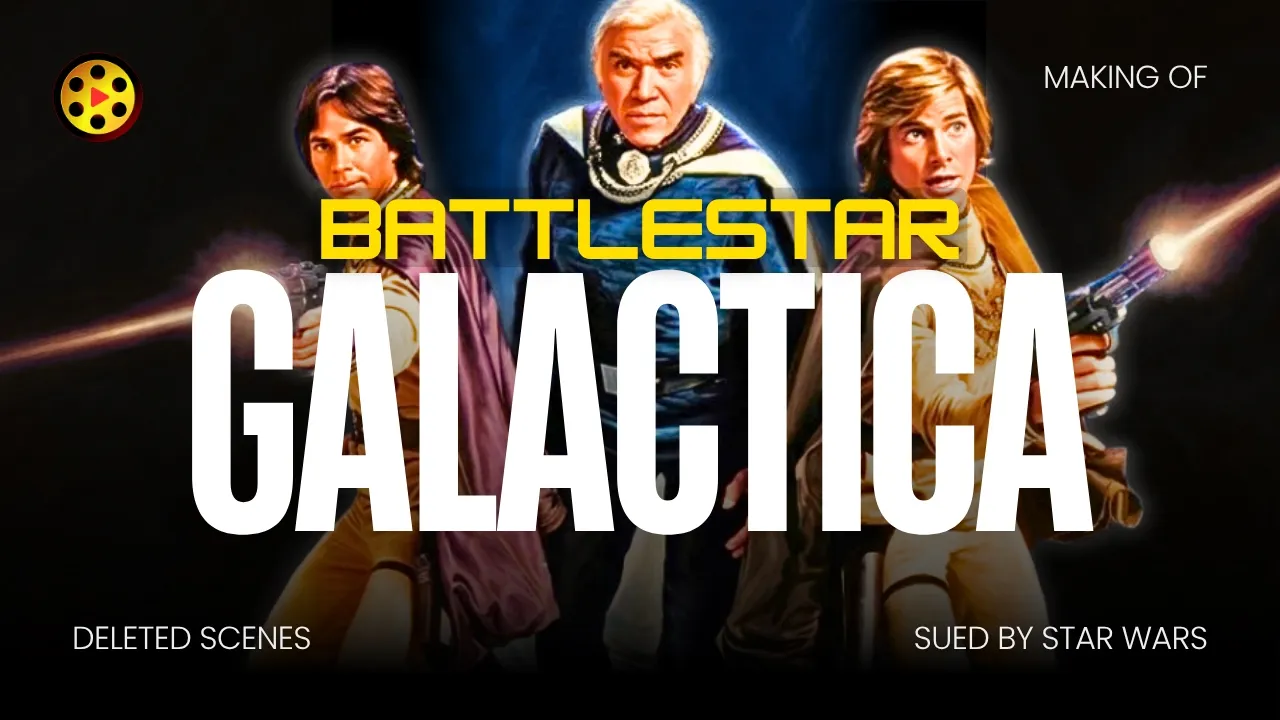
Creator: Golden Flicker · Published: 2026-10-03 · Length: 26:17 · Watch on YouTube
They buried three hours of Battlestar Galactica, and a Star Wars lawsuit nearly ended the show before it began. — video description
1) Detailed outline
[0:00] Cold open: the villain who died twice
- A Canadian cinema audience watches the villain of a brand-new space opera get beheaded.
- Two months later on ABC, in the three-hour pilot, he doesn't die. He dies in the movie cut.
- Thesis: the dual life of 1978 Battlestar Galactica — TV pilot released as a film first; sued by 20th Century Fox before broadcast; effects made by the Star Wars crew, in the Star Wars building, with the Star Wars camera; and more than three hours of scenes filmed that "nobody was meant to see."
[0:51] Glen A. Larson & the origins
- Glen A. Larson: former member of the 1950s vocal group The Four Preps; one of Universal Television's busiest producers.
- Since 1968 he had carried an idea called Adam's Ark. Mentor: Gene L. Coon (producer of original Star Trek).
- First form: a reclusive billionaire launches Earth's finest minds into space to escape apocalypse. Larson later reversed it — journey begins out there and ends at Earth. Nobody wanted it.
- May 1977: Star Wars opens. Larson never hid other sources — Mormon origins, Greek mythology, pyramids, von Däniken's Chariots of the Gods.
- Series DNA drawn from those roots:
- Colonies ruled by a Council of 12.
- Couples sealed in marriage "for this life and the next" / "all the eternities."
- Mother world Kobol as anagram of Kolob, a star in Mormon scripture.
- Cylon massacre = Pearl Harbor in space; survivors' flight = exodus. Structure is the trek, not the destination.
[2:28] The Star Wars lawsuit
- Autumn 1977: Universal sends Lucas a script titled Galactica: Saga of a Star World.
- Lucas objects to three things: "Star World" in the title; heroes named Starbuck and Skyler; robots called droids.
- Universal drops "Star World"; Skyler → Apollo (Richard Hatch later confirms his original name was Captain Skyler). "Droids" redubbed to "drones" in Dr. Wilker's lines (Boxey / droid training dialogue).
- 23 June 1978, before a single episode airs: 20th Century Fox sues Universal, listing 34 alleged similarities with Star Wars.
- Universal countersues, claiming Star Wars lifted from Universal's own 1972 film Silent Running.
- Judge dismisses Fox's case in August 1980 ("vastly different when viewed as a whole"). Appeal revives it in 1983; finally settled out of court on undisclosed terms.
[3:49] A $9 million television-movie budget
- Universal hires contract director Richard A. Colla.
- In a 2008 interview, Colla says Larson sold it to ABC as a TV movie for $1.8M. Summing department budgets, Colla got ~$9M. That gap, in his telling, is why Universal had to release the pilot in cinemas to recover costs.
- Trade press: final cost ~$8M (one of the most expensive TV films to that point). Universal advertising: "$14 million."
- Colla thought the script read like a comic book but shot it like a feature: long dollies, wide masters, few close-ups.
- Cinematographer Ben Colman ("Lord of Darkness") lit so darkly the studio hated the lack of coverage/"artsy craftsy" distance.
- With four days left, Colla is fired. Actor Wilfrid Hyde-White later said he was half an hour behind. Colla called Larson an "ungrateful bastard."
- Alan J. Levi (already preparing the next episode) takes over; rewrites/reshoots shrink Colla's share to ~half the finished pilot.
- John Dykstra: final tally 57 shooting days, 30 over schedule.
[5:52] John Dykstra, Apogee, and the Galactica visual effects
- After Star Wars, ILM goes quiet. Supervisor John Dykstra stays in the same Van Nuys warehouse and founds Apogee, keeping the motion-control Dykstraflex.
- Credits read like a Star Wars reunion: Richard Edlund, Dennis Muren (effects photography); Grant McCune (chief model maker); Ralph McQuarrie and Joe Johnston (design). Muren: some Galactica shots came out better than Star Wars.
- Bridge gags composed in-camera: live set + actors + charges + falling beams + monitor playback + front-projection, all synced to 24 fps.
- Cylons designed by Andrew Probert and Joe Johnston. First conceived as blind living creatures (hence the sweeping scanner instead of eyes). Larson wanted something like a human skull; designers avoided stormtrooper resemblance. For 8pm TV, machines can be killed without limit → Cylons become robots.
- Cylon leader: reptilian puppet credited to Carlo Rambaldi (later E.T.); close-ups rarely used; "the lizard was lost." Same remote-mask approach for the Android Sisters.
- Lucas accused Apogee of using equipment Star Wars had paid for → gear returns to ILM; Universal Hartland takes over. Work wins an Emmy for creative technical crafts (Dykstra, Edlund, physical-effects chief Joe Goss). When Lucas restarts ILM in Northern California for Empire, Edlund and Muren go; Dykstra does not.
[8:35] Casting Adama, Apollo, and Starbuck
- Lorne Greene (Bonanza's patriarch) as Commander Adama.
- Hardest cast: Starbuck. ABC reportedly wanted Don Johnson. Dirk Benedict did five screen tests; network kept saying no ("not sexy enough"). He was hired two hours before shooting a scene that didn't match the pages he'd learned.
- Starbuck's cigar was Benedict's idea from a screen test; Larson wrote it in. Network hated it; fans mailed him boxes of cigars.
- Jane Seymour signed for one TV movie. She thought she was playing a TV journalist with a dramatic arc; in the finished film almost every speaking scene was cut. Surviving beats: contaminated food from Cylon neutron weapons; she knows she is dying and asks Apollo to look after Boxey.
[10:20] Theatrical film vs. the three-hour TV pilot
- Per Dykstra: the ~2-hour cinema version was edited first; the ~3-hour TV pilot is an expansion. Film is not a shortened episode — TV is a lengthened film.
- Film opens Canada, 8 July 1978, 75 screens, ~$500K in first three days; then Japan and Europe. TV pilot premieres 17 September 1978.
- Runtimes cited: film ~2:04; TV ~2:17+ (the broader "three-hour" framing covers the event/airing package).
- Key differences:
- Baltar dies in the film (beheaded by Centurion). TV version spares him for public execution that never lands; a later epilogue keeps him alive with sidekick Lucifer.
- Carillon fuel-mine explosion: film looks almost accidental; TV has Starbuck volunteer to stay and ignite the tylium.
- Jane Seymour's Caprica newscast: seconds in film, ~2 minutes on TV as bombs fall.
- Only TV: Adama confesses to Athena that he chose who boarded ("like God, passing out priorities"); Apollo explains to Boxey that Cylons were once a reptile race whose machines outlived them.
- Film keeps 3 seconds of a man on fire on the bridge of the Atlantia.
- Frame: shot full-frame 35mm; cinemas mask for widescreen → old VHS shows more picture than widescreen.
- Launch-tube love scene: Cassiopeia is a socialator (upmarket escort) in the pilot; network later makes her a nurse. Early Canadian prints had Starbuck shirtless; ABC demanded a closed reshoot with shirt on for "kid time."
- Mid-video subscribe gag framed as electronic countermeasures / Golden Flicker membership.
[14:39] Chaos of a weekly network schedule
- Larson's plan: a 7-hour event (3-hour pilot + two 2-hour films). ABC ordered 13 more hours before the pilot was finished and wanted it on air that autumn.
- Result: feature-film ambition on a weekly TV treadmill.
- Rewritten pages arrive mid-shoot; actors can't tell which show they're in. Two or three episodes filmed at once; wrong-script pages mix into a strategy-meeting scene (cast staring into space / Herb rocking back toward his birds).
- Writers of Murder on the Rising Star get a one-line premise at ~3:30 Wednesday with no story; must be in mimeograph Friday 7am.
- Every Friday: looping stage to re-record dialogue + "Viper day" — all cockpit shots back-to-back. Actors in a mock-up before a 3–6 second projected space battle; slow line delivery → blank white screen. Crew yanks the mock-up to fake banking. Prank: Hatch sees Benedict's Viper drifting the wrong way beside him.
- Cylon armor: vacuum-formed mirrored plastic over leotard — hot, noisy, reflects camera. Every Centurion a stuntman with pyrotechnics; basketball/football players hired. Eye-slit vision ~2–3 feet → trips and domino pileups; directors laughing too hard to say cut.
- Boxey's daggit Muffit: young chimpanzee Evie in a costume. She removes her own head when done; trainer removes the head so she can see him, then replaces it. During the pilot escape she bolts into the rafters — filming stops ~3 hours.
- Standards and Practices: a Sheba/Apollo (or similar) take ends with a line that makes cast burst laughing — "nothing can harm you as long as I am inside you" — and censors kill it.
[20:09] Three hours of deleted scenes ("Golden Flicker moment")
- Why so much unused footage? Pilot shot/reshot/cut into several versions; weekly episodes overran slots; Universal kept everything to reuse. Much resurfaced in 1980s syndicated TV-movie recuts never released on disc.
- Story-changing cuts called out:
- Adama's resignation / breakdown (ABC cut keeps only half); Apollo calling it cowardice.
- Fred Astaire featurette vs. deleted coaching ("You're not dancing now… Look at me, Fred").
- Starbuck's backstory cut: agro city Umbra / thorn forest destroyed in sneak attack year 7322; orphaned children wandering the forest.
- Series-finale line cut that echoes the title: riding in an open bubble is "like riding in the hand of God."
- Lighter cut: Starbuck and children in The Young Lords recite a nursery-rhyme escape plan.
[22:46] Why ABC cancelled in 1979
- Premiere 17 September 1978: huge event. Mid-broadcast ABC interrupts for the signing of the Camp David Accords, then resumes. That night Alan Alda, hosting the Emmys, jokes "Don't you wish you were home so you could watch Battlestar Galactica?"
- Fifth highest-rated program of the week; cast recall 60–70 million / highest-rated network sci-fi debut.
- Wins its Sunday slot until CBS cancels Mary (Mary Tyler Moore variety) after three episodes and moves All in the Family into Galactica's hour. Share falls from ~45% to 27–28%. For the most expensive series on TV, third place isn't enough.
- Cancelled Monday, 23 April 1979 — no announcement, no proper finale; just gone.
- Meanwhile the film's second life: November 1978 quiet cinema tests in San Antonio, Memphis, Phoenix with Sensurround (from Earthquake). Phoenix house: >$28K first week. UK/Ireland open 15 April 1979; US 400 cinemas 18 May 1979 (less than a month after cancellation). International theatrical: >$41M.
- ABC then asks Larson for a film where the fleet reaches Earth → Galactica 1980: smaller budget, new cast, early-Sunday educational remit; cancelled after 10 episodes.
[25:24] Legacy of Kobol and the 2003 reimagining
- Richard Hatch spends two decades trying to revive it; remortgages his home to shoot a trailer for sequel The Second Coming; finds sets/props in storage (not on the Universal lot).
- 2003 reimagining: darker, more political — closer in spirit to the slow, shadowy film Colla had been trying to make in 1978. Hatch joins as rebel Tom Zarek.
- Outro: like/share/subscribe; ask which film to cover next.
Key takeaways
- The cinema cut and the TV pilot are not the same object with different lengths — the film was cut first; TV expanded it (and later epilogues changed character fates, notably Baltar).
- Legal and industrial entanglement with Star Wars was real: script notes from Lucas, redubs, a 34-point Fox lawsuit, and Apogee/ILM equipment politics.
- Feature ambition on a weekly ABC schedule produced chaos (wrong pages, looping Fridays, Viper day, Cylon pileups) and a vault of reuse footage.
- Ratings collapse after CBS counter-programming — not creative failure alone — drove the April 1979 axe, even as theatrical/international money kept pouring in.
- Buried material (Adama resignation, Fred Astaire coaching, Starbuck orphan backstory, "hand of God") and Hatch's persistence bridge the original to the 2003 remake.
2) Things mentioned
Shows, films and cuts
| Item | What it is / why it's in the video |
|---|---|
| Battlestar Galactica (1978) | ABC/Universal space opera; dual theatrical + three-hour TV pilot life is the core subject. |
| Saga of a Star World | Pilot title (early form Galactica: Saga of a Star World). |
| Silent Running (1972) | Universal's Douglas Trumbull film, cited in Universal's countersuit against Fox. |
| Star Wars (1977) | Industrial and legal shadow over the whole production. |
| The Empire Strikes Back | When Lucas restarts ILM in Northern California; Edlund/Muren leave Apogee. |
| Galactica 1980 | Short-lived Earth-reach follow-up; cancelled after 10 episodes. |
| Murder on the Rising Star | Episode whose writers got a one-line premise midweek with a Friday mimeograph deadline. |
| The Young Lords | Episode with the nursery-rhyme escape-plan cut. |
| Bonanza | Lorne Greene's long-running Western; casting credibility for Adama. |
| Earthquake | Source of the Sensurround rumble system used in Galactica cinema tests. |
| Battlestar Galactica (2003 reimagining) | Darker remake; Hatch returns as Tom Zarek. |
| Hatch's The Second Coming trailer | Fan/producer revival attempt he funded by remortgaging his home. |
Networks, studios and facilities
- ABC (commissioner/canceller; Standards and Practices), CBS (moves All in the Family into Galactica's slot), Universal Television / Universal theatrical, 20th Century Fox (lawsuit).
- Industrial Light & Magic (ILM), Apogee (Van Nuys warehouse), Universal Hartland (in-house effects after equipment dispute).
- Cinema tests: San Antonio, Memphis, Phoenix; Canadian opening 75 screens; later 400 US cinemas.
Production, craft and behind-the-scenes
- Dykstraflex motion-control camera; in-camera bridge destruction; matte shots and miniatures; Emmy for creative technical crafts.
- Cylon Centurion armor (vacuum-formed mirrored plastic), pyrotechnic stunt casting, scanner-eye design, Rambaldi reptilian Imperious Leader puppet, Android Sisters remote masks.
- Viper cockpit mock-up / "Viper day"; looping Fridays; mimeograph scripts; multi-episode simultaneous shooting.
- Socialator → nurse rewrite for Cassiopeia; shirt-on/shirt-off launch-tube reshoot.
- Sensurround theatrical differentiation from free TV.
- Camp David Accords mid-premiere interruption (17 Sep 1978).
People, roles and characters named on screen
- Glen A. Larson (creator/producer), Gene L. Coon (mentor), George Lucas, Richard A. Colla / Alan J. Levi (directors), Ben Colman (DP), John Dykstra, Richard Edlund, Dennis Muren, Grant McCune, Ralph McQuarrie, Joe Johnston, Andrew Probert, Carlo Rambaldi, Joe Goss.
- Cast: Lorne Greene (Adama), Richard Hatch (Apollo / later Tom Zarek), Dirk Benedict (Starbuck), Jane Seymour (Serena), John Colicos (Count Baltar — dies in film), Wilfrid Hyde-White, Don Johnson (ABC's reported Starbuck preference), Fred Astaire (deleted-scene coaching), Alan Alda (Emmy host joke), Mary Tyler Moore (Mary), chimpanzee Evie (Muffit).
- Characters/places: Boxey, Athena, Cassiopeia, Sheba, Tigh, Lucifer, Kobol/Kolob, Carillon, Atlantia, Umbra, Caprica.
Books / cultural references
- Erich von Däniken, Chariots of the Gods; Mormon scripture (Kolob); Greek mythology / pyramid lore; Pearl Harbor and Exodus metaphors.
3) Biographies
Golden Flicker (host / channel)
YouTube channel (@GoldenFlicker, channel ID UCTXVukXhAK7a5GjXaNHPT-Q) devoted to "hidden histories of 20th-century cinema" — deleted scenes, alternate cuts, lawsuits, and production chaos around classic film and TV (often 1970s–80s sci-fi, fantasy, and animation). Roughly weekly uploads; about 84K subscribers around the time of this video. House style: archival clips in a distressed film-frame border with a GOLDEN FLICKER watermark, interview bites, and a mid-video "Golden Flicker moment" beat that names the buried footage thesis.
Glen A. Larson (creator)
American television producer and writer (1937–2014). Began as a singer in The Four Preps, then became a high-output Universal TV producer. Created or shepherded Battlestar Galactica, Galactica 1980, Buck Rogers in the 25th Century, Knight Rider, Magnum, P.I., The Fall Guy, and others. Long carried the Adam's Ark idea that became Galactica after Star Wars proved space opera could sell. Openly cited Mormon cultural motifs, von Däniken, and mythic structures as influences.
Lorne Greene (Commander Adama)
Canadian actor (1915–1987), best known as Ben Cartwright on Bonanza (1959–1973). Cast as the patriarchal Commander Adama; his Western-TV authority was part of Galactica's mainstream pitch.
Richard Hatch (Captain Apollo)
American actor (1945–2017). Originally cast when the character was still Captain Skyler; renamed Apollo after Lucas's objections. Later spent years pushing a sequel (The Second Coming trailer), then joined Ronald D. Moore's 2003 reimagining as political prisoner/rebel Tom Zarek.
Dirk Benedict (Lieutenant Starbuck)
American actor (b. 1945). Won the role after multiple rejected screen tests (network preferred someone like Don Johnson). Invented Starbuck's cigar in a test; known for the launch-tube reshoot stories and Viper-day anecdotes. Later famous as Face on The A-Team.
Jane Seymour (Serena)
British actress (b. 1951). Signed for a single TV-movie appearance; believed she had a substantial journalist arc. Most of her dialogue was cut from the finished film, leaving the dying-mother / Boxey handoff as her clearest surviving through-line.
John Dykstra (VFX supervisor)
American special-effects artist; Oscar-winning Star Wars effects supervisor who invented the Dykstraflex motion-control system. Founded Apogee in the Van Nuys ILM space to do Galactica; shared an Emmy for the show's effects; stayed behind when Edlund and Muren rejoined Lucas for Empire.
Richard A. Colla (pilot director)
American director/actor; Universal contract director hired for the Galactica pilot. Shot it dark and cinematic; fired with days left on the schedule amid coverage disputes and overruns. Later interviews (incl. ~2008) are a major source for the video's budget and firing narrative. Alan J. Levi finished/reshot large portions.
John Colicos (Count Baltar)
Canadian actor (1928–2000). Plays the traitor Baltar — executed in the theatrical cut, spared (then paired with Lucifer) for ongoing TV. The cold-open "died twice" gag is about these dual fates.
Carlo Rambaldi
Italian special-effects artist (1925–2012), later famous for E.T. the Extra-Terrestrial and Alien. Credited here with the reptilian Imperious Leader puppet.
Gene L. Coon
American writer-producer (1924–1973), key architect of original Star Trek's tone and many episodes. Named as Larson's mentor in the origins section.
Fred Astaire
Legendary dancer/actor (1899–1987). Appears in the deleted-scenes section via a featurette and outtakes of a director coaching him through a non-dance dialogue beat — presented as one of the vaulted cuts that change how the production is remembered.