Creator: Maxinomics · Published: 2026-05-29 · Length: 18:26 · Watch on YouTube
There's a piece of data that almost nobody is paying attention to that is, right now, telling a story about the United States that most people on the coasts simply cannot feel. It starts with a weird question: why is it nearly impossible to book a flatbed truck? (video description)
1) Detailed outline
[0:00] The most important signal in America: the flatbed
- A data thread that kept "returning to the exact same place." Sponsor tease: tastytrade.
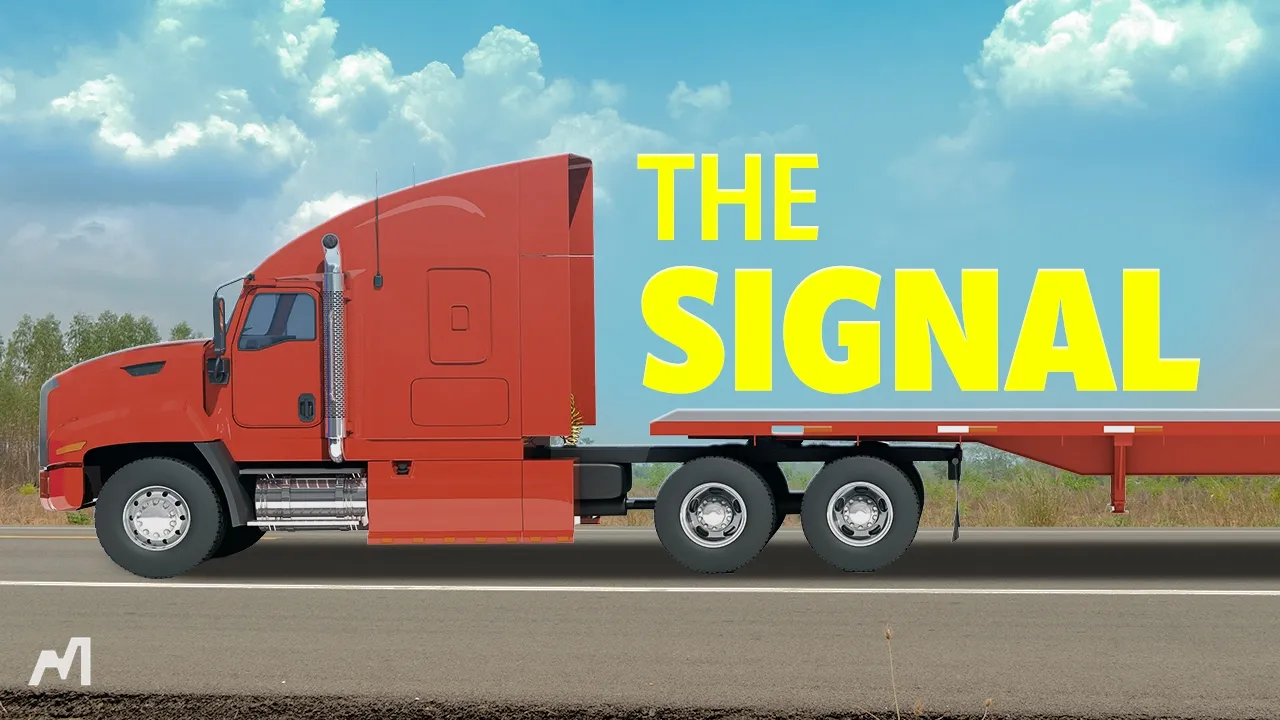
- The flatbed: no walls, no ceiling, 53 ft long, 11.5 ft wide. Easy to steal from, can't keep lettuce cold, cargo gets wet: "not the best way to move 90% of cargo." So why is it almost impossible to book one?
- That answer led Phil to say in a presentation: "I've never been this bullish on the United States economy before."
[0:41] "Industrial renaissance" talk vs. freight data
- It started with a tweet repeating the "industrial renaissance" line, a decade-old promise from every politician: the U.S. only buys from overseas, goods flow through ports to Main Street, leaving consumers at the whim of suppliers.
- What stopped him was the phrase freight data. Framework: separate what people say (spin) from what people do (can't be faked).
- "We're bringing manufacturing back" is talk; "we're paying truckers twice what we were six months ago" is action. If prices doubled and companies pay anyway, that's a choice.
- Revealed preference example: Netflix ended password sharing, everyone said "I'm canceling," and within days Netflix had its four largest single days of sign-ups ever.
[2:18] Ruling out the easy explanations
- Fewer trucks? There has been a crackdown on commercial driver licenses, but it's a very small part of the story.
- Diesel? Oil topped $100/barrel recently, but fuel explains only about 24 cents, ~8%, of the rate jump.
- Tariffs? Maybe goods ordered months ago, with tariffs up, down and in court, are all landing at the ports. The data says no, which sends Phil to call in an expert.
[3:25] Craig Fuller and the inverted freight map
- Craig Fuller built FreightWaves ten years ago, the industry-standard freight-market platform used by thousands of shippers and carriers.
- The usual pattern: coasts heat up first (tender rejections and volumes around Los Angeles, Savannah, Newark), and a couple of weeks later the freight reaches the interior. That map held for three decades.
- Today's map is red-hot in the middle of the country, while the coasts are barely participating.
- Fuller calls it the I-35 corridor: the old Rust Belt down to Texas. Demand and volume are surging and rejections are "going hyperbolic." The center of the country has gone from receiving freight to driving it, evidence that the industrial activity is actually working.
[5:18] Freight as the economy's pipes
- Freight is the cable between businesses: ore from mine to smelter, steel sheet to factory, factory to construction site. If the ports aren't the source, every section of pipe must be full: raw materials in, finished goods out, warehouses emptying as fast as they fill.
- ~50% of all flatbed loads are being rejected. Consumer goods don't ride flatbeds (Amazon doesn't deliver on one); flatbeds carry steel coils, equipment and lumber. It is industrial trucking.
[6:12] A short history of the flatbed
- The flatbed (1898: four wheels and a deck) survived because some cargo can't fit in a box.
- Walls and a roof came in the 1920s as trucking competed with rail (the dry van); refrigeration in the 1930s created the reefer.
- About 450,000 active flatbed trucks are available for dispatch. Trucks are mobile and the industry is hyper-reactive, so a temporary imbalance resolves in one to two weeks. This one hasn't. Fuller: "This is fundamental. Our industrial economy is cooking," something not seen in 20 years.
- Last year was "abysmal" for industrials. "But then something happened."
[7:28] Sponsor: tastytrade
- Supply shocks keep rippling through prices (oil, chips, memory, software, copper, now freight). Pitch for tastytrade as an options-focused active-trading platform.
[8:20] Big Tech's accidental stimulus
- Hyperscaler capex is, in a roundabout way, Big Tech giving back years of accumulated cash while racing each other on AI.
- Effect one: huge sums flow into sectors that haven't moved like this in a long time. Ten years ago a board would have told a CEO to "kick rocks" over a plan to spend $150 billion on data centers in 2026; now they see it as survival.
- Effect two: for heavy and light AI users alike, serving you costs these companies far more than you pay. Call it a consumer-surplus subsidy: the world's knowledge scraped, compacted and given away "on the house."
[9:25] Black swans, the kind everyone remembers
- "A rare bird upon the earth, exceedingly like a black swan": a Roman poet's line meant "impossible," repeated with total certainty for 1,500 years.
- Then 250 men on three ships entered a river on Australia's west coast thick with black swans. One sighting invalidated a certainty that millions of white swans had "confirmed."
- Bell-curve explanation using human height: ~80% cluster in the middle, nobody is 100 ft tall. Betting that the next event lands under the curve is usually the safest way not to lose money, until a dot lands far outside it.
- Negative black swans are memorable (9/11): fear, panic, headlines.
[11:12] The more powerful kind: positive black swans
- In WWII, infections, not bombs or bullets, caused about one in five deaths.
- A messy scientist (Alexander Fleming, not named on screen) left petri dishes out on vacation. Mold from three floors below drifted up and killed the bacteria around it: penicillin, which made zero headlines.
- The high-yield production mold was later found on a cantaloupe in Illinois. By the war's final year, infection deaths fell from one in five to under one in 100, and hundreds of millions of lives have been saved since. A positive black swan.
- Quibbles aside about what was predictable (9/11 plotters, housing-crash skeptics), nobody predicted the wheel, the steam engine, the car, photography, the internet, or "this tweet": the launch of ChatGPT, "one of the worst-named products" in history.
[13:00] AI productivity vs. internet productivity
- Chart: official U.S. productivity (output per unit of input), with the internet (blue) and ChatGPT (yellow) lines anchored to each one's public launch.
- The ChatGPT line is already significantly above the internet line, meaning productivity is growing faster than after the internet arrived.
- Caveat: it could be noise, and you can't definitively say AI caused it. But if it keeps up or beats the internet's path, it's hard to read as anything but bullish for America and the world.
[13:54] Why it doesn't feel like it, and the bull case
- AI landed just as the U.S. started building things again, and Big Tech is "dumping fuel" on that fire. The middle of the country and the information economy are firing together, which Phil says he hasn't seen in his lifetime; the heartland has been in decline his whole life.
- People on the coasts can't feel the middle of the country. 60%+ of Americans own stocks, mostly concentrated in the ~10 megacaps fighting each other, while the companies benefiting from their spending don't make headlines.
- Repeats: "I've never been this bullish on the U.S. economy." Bumps, yes; the trend is worth thinking about.
- Third black swan teaser: rockets that land themselves open a new frontier (ocean-crossing ships, westward railroads). That's the next video.
[15:10] Footnotes
- Natural gas: the U.S. is effectively an island, so gas can't easily be exported by pipeline, and Canada and Mexico already have plenty. Gas generates most electricity in most countries, factories want it, and it's about 15x cheaper in the U.S. than Europe or Japan and ~4x cheaper than China. Fuller: pipelines and infrastructure make energy "our greatest story of the next decade." ~40% of heavy-manufacturing cost is energy, more than labor. Germany became an "industrial basket case" by decommissioning energy supply. Cheap energy alone doesn't offset high U.S. costs, but it's real and stable, which matters to anyone penciling out a factory.
- It's not just trucks: rail freight is jumping too, with chemical and grain shipments at 20-year or all-time highs. Caterpillar backlog is at an all-time high with revenue following, and its factories sit in the hot zone. Others named: Nucor steel, John Deere, Archer Daniels Midland, Generac, Eaton.
- Robotics is about to step onto the main stage alongside AI and space.
- CTA: four in five regular viewers aren't subscribed; subscribers help greenlight more videos and possible live events. Next: the SpaceX / new-frontiers video.
2) Things mentioned
Economic signals and data
- Freight data as revealed preference (what companies do, not say).
- Tender rejection rates: ~50% of flatbed loads rejected.
- Trucking rates roughly doubled in six months; diesel explains only ~$0.24 (~8%).
- ~450,000 active flatbeds; normal imbalances clear in 1–2 weeks.
- U.S. productivity chart, ChatGPT era vs. internet era.
- 60%+ of Americans hold stocks, concentrated in ~10 megacaps.
- Rail chemical and grain carloads at 20-year / all-time highs.
Companies and products
- FreightWaves (freight-market intelligence platform).
- Netflix password-sharing crackdown and record sign-up days.
- Amazon (consumer delivery, not flatbeds).
- Hyperscalers' ~$150B data-center build-out; ChatGPT.
- Caterpillar (record backlog), Nucor, John Deere, Archer Daniels Midland, Generac, Eaton.
- Truck types: flatbed, dry van, reefer.
- Sponsor: tastytrade.
Markets, energy and policy
- "Industrial renaissance" and reshoring rhetoric; tariffs in and out of court.
- Crackdown on commercial driver licenses.
- Oil above $100/barrel.
- U.S. natural gas ~15x cheaper than Europe/Japan, ~4x cheaper than China; energy ~40% of heavy-manufacturing cost.
- Germany's energy decommissioning and industrial slump.
- Consumer-surplus subsidy from below-cost AI services.
Places
- Ports: Los Angeles, Savannah, Newark.
- I-35 corridor, the old Rust Belt, Texas.
- West coast of Australia (black swans); World Trade Center (9/11); Illinois cantaloupe.
Ideas and frameworks
- Revealed preference.
- Freight as the economy's pipes and a hard-to-fake signal.
- Black swans: negative (memorable) vs. positive (more powerful, quiet).
- Bell curve and tail events.
- Hyperscaler capex as accidental stimulus.
- Teasers: rockets as a new frontier; robotics next.
3) Biographies
Maxinomics (channel / host)
Morning Brew's economics channel (@Maxinomics), presented by producer Phil Andrews. This episode is his macro bull case for the U.S. economy, built on freight data, and it sets up the following SpaceX "new frontier" video. Credits from the description: video editor Christie Muldoon, motion graphics Luca Depardon, director of production services Sam Wolf, thumbnail Tom Grillo, franchise content producer Tariq Abdellatif, and Morning Brew president Devin Emery.
Phil Andrews (on-camera producer)
"The guy in the videos and the comments." Narrates the investigation from the flatbed puzzle through the ruled-out explanations, the Fuller interview, black swans and the productivity chart, and delivers the "never been this bullish" line.
Craig Fuller (guest)
Founder of FreightWaves, built about ten years before the video, which the episode calls the industry-standard real-time freight intelligence platform. Interviewed on the inverted freight map, the I-35 corridor, flatbed rejections and U.S. energy as "our greatest story of the next decade." On X as @FreightAlley.
Alexander Fleming (as framed, not named on screen)
The "very messy man" whose uncovered petri dish, contaminated by drifting mold while he was on vacation, led to the discovery of penicillin. Used as the archetypal positive black swan.
The Roman poet (Juvenal, as background)
The "rare bird upon the earth, exceedingly like a black swan" line comes from the Roman satirist Juvenal. The video doesn't name him; it uses the line as the origin of the black-swan-as-impossible idea that held for 1,500 years until Europeans reached western Australia.