Creator: Maxinomics · Published: 2025-09-16 · Length: 24:08 · Watch on YouTube
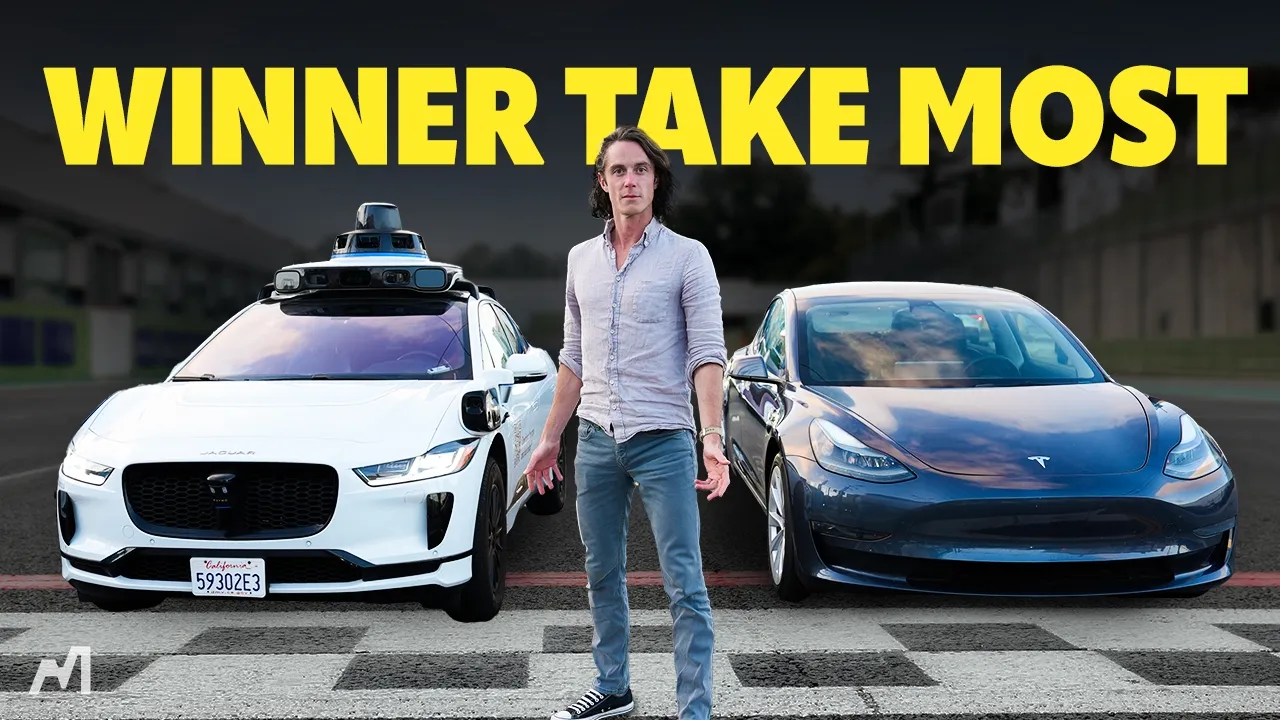
A massive battle for the future of driving is underway between Tesla and Waymo, whose completely opposite strategies mean that if one succeeds, the other may become obsolete. To see who's really winning, we put both self-driving systems to the test in a head-to-head challenge on the chaotic streets of San Francisco. (video description)
1) Detailed outline
[0:00] Intro: a rivalry headed for the history books
- Phil puts Tesla versus Waymo on track to join a list of famous rivalries: Netflix vs. Blockbuster, MySpace vs. Facebook, BlackBerry vs. iPhone.
- Self-driving taxis "are not just coming, they're here": in San Francisco you can't go a block without seeing one. A news clip says Waymo has passed 10 million fully driverless rides, going from zero rides five years ago to about 100,000 a day.
- Tesla has now launched its own robotaxis. What makes the fight interesting is that each company's strategy is "almost completely a bet that the other company's strategy is dead wrong," so if one works the other will likely look obsolete, the way Apple's full touchscreen ended BlackBerry's hardware keyboard.
- Tesla launched about five years behind Waymo, so Phil designs a test: three San Francisco destinations, three rides in each car, no human intervention allowed, and a stopwatch on every leg. He says he was "genuinely surprised" by the results.
[1:38] The bet
- Tesla's bet: a human with two forward-facing eyes can drive, so a car with eight high-definition, wide-angle cameras looking in every direction at once should be able to as well.
- Roads are built for human vision: yellow is used for critical warnings because people see it most easily at long distances, and sign layouts follow exact patterns.
- The Manual on Uniform Traffic Control Devices (MUTCD) is 1,113 pages long (chapter 2 alone is 92 pages). It specifies, for example, that the first letter on a particular exit sign is 6 inches tall and the whole sign 52 to 55 inches wide, and Phil confirms the measurements in the field.
- The manual even tells planners to place signs at "natural target locations" right where drivers will need to act. Phil calls it "programming... code but for humans in a 3D environment." If you give a car human-or-better vision and a brain, it should drive better than a human.
- Waymo's bet: a car lacks human intuition, so it must make up for it with raw input that can't be blinded by conditions.
- Weather is why every company starts in Phoenix, Las Vegas, or Austin: sunny about 300 days a year, little rain, and wide, new roads built for booming populations. Nobody runs fully autonomous vehicles outside the Sun Belt, where the real enemy (snow and ice) is absent.
- Waymo has been operating there for over five years. Its cars carry cameras, microphones that hear emergency vehicles, and a roof-mounted lidar unit that spins, sends out signals, and times their return to map what objects are where, how fast they're moving, and in which direction. It doesn't need light, so it works in the dark and can, in theory, see through conditions that jam cameras or eyes.
- The trade-off in one line: 29 sensors on a Waymo vs. eight cameras on a Tesla; expensive vs. cheap; more data vs. less data.
- Whoever loses will probably have to adopt the winner's system, because this is likely a winner-takes-most market, like VHS over Betamax and Blu-ray over HD DVD.
[5:03] Electricity wars with Thomas Edison
- In the 1890s, as electricity was becoming a household word, everything favored Edison: money, fame, and J.P. Morgan's backing. He championed direct current (DC), which flows one way but required a power plant within about a mile of where the power was used.
- Nikola Tesla took the other side with alternating current (AC), which could be generated in one place and pushed hundreds of miles down power lines.
- Phil says the fight "got dirty": Edison publicly electrocuted a horse in New York to scare people off AC and arranged for the first U.S. electric-chair execution to use AC for the bad publicity.
- AC was obviously better and won anyway. Edison was sidelined in his own company, and the DC system he built was torn out and rebuilt with AC, a system worth hundreds of billions of dollars today.
- Phil names the game-theory type that both this saga and Tesla vs. Waymo fit: a stochastic sequential game with delayed feedback.
- Sequential: moves come one at a time. Tesla used to have a front-facing radar in the bumper and removed it, signaling comfort with fewer sensors; Waymo now runs four lidar units per car but has cut sensor costs, signaling it can get cheaper.
- Delayed feedback: time has to pass before anyone knows whether a move was right.
- Stochastic: it all plays out in the noisy, unpredictable world of human streets.
[6:53] The race
- Course: start at a parking area by the Golden Gate Bridge; leg 1 is a short 1.3 miles downtown (to a Lululemon store); leg 2 is 3.4 miles across town (to Plow); leg 3 is the longest, about 7 miles back to the start. Each car picks its own route.
- What's measured: whether each car can finish every leg without a human taking over, and how long each leg and the full circuit take. Phil explains a "critical disengagement": alarms sound, the screen flashes red, and the car makes the human behind the wheel take over.
- Tesla, leg 1 (8:48): mostly highway. Someone honked after merging onto a four-lane road (Phil says she was in the wrong). The Tesla correctly stopped when another driver ran a stop sign, which Phil found "fairly impressive." He notes viewers will point out you're supposed to keep a hand on the wheel and pay attention.
- Tesla, leg 2 (23:54): the hardest leg, straight through dense traffic, construction, and pedestrians. Phil spots a Zoox, Amazon's driverless car and in his view the second brand after Waymo, the first he has ever seen. A fallen safety cone in the middle of the lane left the Tesla stopped and unsure, and Phil took over.
- Correction mid-video: Phil pauses to say it wasn't really a critical disengagement, because the car never flashed red or demanded a takeover. He stepped in first, and the car might have worked it out.
- Tesla, leg 3 (30:30): downtown and back to the bridge with only routine city cut-offs. Along the way he sees a new-style Waymo built on a Zeekr vehicle and says that Waymo's progression of vehicles (a van, then the Jaguar, now the Zeekr) shows it keeps improving. He tells viewers to expect autonomous vehicles in cities, though "the Tesla looks better."
- Tesla total: about 63 minutes with one possible, unclear intervention, "much smoother than I'd expected."
- [12:30] Sponsor: Ground News. Phil describes the site as a way to see left, center, and right coverage of a story, with a "blind spot" section, per-story summaries, and source-ownership labels. He offers a 40% discount on the Vantage plan via groundnews.com/maxinomics.
- Waymo, leg 1 (12:23): took a calmer, completely different route than the Tesla, avoiding the hilly, busy center. It was about 4 minutes slower.
- Waymo, leg 2 (24:51): Phil notes that a slower car means fewer passengers per hour and more electricity per trip, so a consistent 20 to 25% gap would be significant. He expects zero critical disengagements, and says Waymo riders can hit a support button so a remote control center can take over. Waymo drove the same road with the same cone (now set upright) and "zipped right around" it. Phil allows that the cone sat a bit more in the right lane, but gives the point to Waymo.
- Waymo, leg 3 (about 41:45): the app estimated 40 minutes, 8 more than the Tesla, in mid-afternoon (about 2:15) light traffic, with one small hesitation and another Zoox sighting.
- Waymo total: 78 minutes 59 seconds with no problems.
[17:13] What it means
- Phil admits this was not a scientific test: a real one would need multiple circuits over multiple days at different times. This run was in daylight only.
- The Tesla was not a robotaxi but a regular consumer Tesla with the Full Self-Driving package, running software one full version behind the current FSD release and almost two behind what Tesla used in its Austin robotaxi pilot.
- The headline is the roughly 16-minute gap. Running the loop 24 hours a day, a Waymo would finish about six fewer laps than a Tesla. Tesla would pick riders up sooner, drop them off faster, use less battery per ride, and spend less time charging.
- Phil's rough math is that Tesla could cover the same riders with about 25% fewer cars. Even if both cars cost the same, Waymo would take 25% longer to pay off each vehicle while losing riders who prefer the quicker pickup, a "very difficult game of playing catch-up."
[18:34] The cost
- Assume Waymo closes the time gap or the test was wrong. The one deciding factor is who can do the whole thing cheaper, and more narrowly, who can build the vehicle cheaper.
[18:49] Andrew Carnegie and vertical integration
- In 1870 it cost Andrew Carnegie about $100 to produce a ton of steel. The three main costs were iron ore, coal, and transportation.
- Carnegie, a Scottish immigrant, started with one steel mill in Pittsburgh at the same cost as dozens of rivals, so he had "exactly zero advantage." Every input carried someone else's profit margin: the Michigan iron mine, the railroad hauling the ore, the coal mine, the railroad hauling coal, and the railroad shipping finished steel.
- By 1900 he owned large parts of the Mesabi Range iron deposits, thousands of coke ovens, big Pennsylvania coal deposits, 600 miles of railroad, and seven cutting-edge mills. His cost fell to $11.50 a ton while everyone else's was $25.
- That is the "magic" of vertical integration, if you can afford to build it: you stop paying suppliers' margins and you gain control, since changes are no longer negotiations.
- Tesla: only about 35% of the money spent building a Tesla goes to outside suppliers, vs. about 60% for a company like Ford. A mid-tier Ford Bronco costs about as much as a Model Y, and getting the Bronco close in features costs about $8,000 more. Phil calls Tesla the purest vertical integration in U.S. manufacturing since perhaps the 1950s.
- Waymo: the opposite approach. Building cars is outside its core competency, so it buys cars from automakers and fits them with sensors. Phil compares this to Android and Windows, where the software maker licenses to hardware makers like Dell, versus Apple's iOS, which runs only on Apple's hardware.
- The key difference is that cars can't be buggy: there can be "no blue screen of death." Phil argues Android phones and Windows laptops were, and some would say still are, less stable because the hardware isn't purpose-built for the software (Android runs on thousands of phones, iOS on one).
- Waymo's current Jaguar I-Pace was never designed to be autonomous, and the roof unit wasn't on Jaguar's drawing board. Every change has to fit what suppliers will agree to, and each supplier takes a margin.
- Unit cost: the lowest estimates put Waymo's cost at about $100,000 per car, down from about $120,000 three years ago, while Tesla can build a Model Y for about $38,000.
- Scale: an earlier Maxinomics video estimated about 300,000 vehicles could cover most ride-hailing demand in the 30 largest U.S. cities. Tesla's four factories can produce about 900,000 cars a year in the U.S. and 2.35 million globally, so if it reaches regulator-approved full self-driving it could devote just 20% of output to robotaxis and flood the market with shorter wait times and more routes.
- Waymo's answer is the Android way: partner with Chrysler, Jaguar, Hyundai, and most recently and controversially Zeekr. Together they can match Tesla's factories, but every deal has to be negotiated, designed, and tested.
- Geopolitical risk: Zeekr is Chinese. After Senator Rick Scott questioned whether a company with direct ties to the CCP (the Chinese Communist Party) should be listed in New York and power a premier U.S. robotaxi network, Zeekr chose to delist from the New York Stock Exchange and relist in Hong Kong. Phil says the partnership might still work and makes sense for Waymo, but Waymo is playing "whack-a-mole" with one problem after another.
- Closing frame: Tesla can build cars, but can it do the robotaxi part? Waymo can do the robotaxi part, but can it build the cars? Even Apple, with its tight supply-chain control, owns no factories. The real test is whether the model that has dominated the last three or four decades (design the product, write the software, make it somewhere else) can compete with a company that makes it in-house.
2) Things mentioned
Economics, business strategy, and policy ideas
- Winner-takes-most markets / standards wars: Phil's reason the loser will have to adopt the winner's technology.
- Stochastic sequential game with delayed feedback: the game-theory label Phil puts on both the war of the currents and the robotaxi race.
- Vertical integration: owning the supply chain to remove supplier margins and gain control (Carnegie Steel, Tesla).
- Core competency: the business-school reason Waymo doesn't build its own cars.
- Utilization economics: faster trips mean more rides per car, less charging downtime, and quicker payback; the 16-minute gap implies about 25% fewer cars needed.
- Supplier share of build cost: about 35% for Tesla vs. about 60% for Ford.
- Unit cost: Waymo about $100,000 per car (down from about $120,000), Tesla Model Y about $38,000.
- Manufacturing capacity: Tesla about 900,000 cars a year in the U.S. and 2.35 million globally; about 300,000 robotaxis could cover the top 30 U.S. cities.
- Geopolitical and national-security risk: Senator Rick Scott's scrutiny of Zeekr's CCP ties; Zeekr's delisting from the NYSE and relisting in Hong Kong.
- Outsourced manufacturing model: "design it, write the software, make it somewhere else," with Apple as the example.
- Manual on Uniform Traffic Control Devices (MUTCD): the 1,113-page federal rulebook for U.S. road signs and markings.
Companies, organizations, and products
- Tesla: robotaxi launch, a consumer car with Full Self-Driving (FSD), eight-camera vision-only approach, the removed front radar, the Model Y, and the Austin robotaxi pilot.
- Waymo (Google/Alphabet): driverless ride-hailing with 29 sensors, four lidar units, over 10 million rides and about 100,000 a day, a remote support center, and vehicles that went from a van to the Jaguar I-Pace to Zeekr.
- Zoox (Amazon): purpose-built driverless vehicle Phil spotted twice in San Francisco.
- Zeekr (Geely): Chinese EV maker supplying Waymo's newest vehicle.
- Jaguar (I-Pace), Hyundai, Chrysler: Waymo's vehicle partners.
- Ford (Bronco): used as the less vertically integrated comparison.
- Apple (iPhone, iOS), Google (Android), Microsoft (Windows), Dell: the integrated vs. licensed software-platform analogy.
- BlackBerry, Netflix, Blockbuster, MySpace, Facebook: the famous rivalries in the intro.
- VHS vs. Betamax, Blu-ray vs. HD DVD: format wars cited as winner-takes-most precedents.
- Carnegie Steel: Carnegie's vertically integrated empire.
- New York Stock Exchange, Hong Kong Stock Exchange: Zeekr's delisting and relisting.
- Ground News: sponsor (Vantage plan, 40% discount via groundnews.com/maxinomics).
- X (Twitter): Phil's preferred social platform.
- Lululemon and Plow: the San Francisco destinations for legs 1 and 2.
Technology
- Lidar: spinning sensor that maps objects by timing returned signals and works in the dark (Phil loosely calls it a kind of radar).
- Camera-only computer vision: Tesla's approach.
- Radar: Tesla's former bumper radar.
- Microphones for emergency vehicles: on Waymo cars.
- Critical disengagement: when the system forces the human driver to take over.
- Direct current vs. alternating current: the 1890s electricity standards fight.
Places
- San Francisco: the test city, from a parking area by the Golden Gate Bridge to downtown and across town.
- The Sun Belt (Phoenix, Las Vegas, Austin): where autonomous fleets start because of the weather and wide new roads.
- Austin: site of Tesla's robotaxi pilot.
- Pittsburgh: Carnegie's first mill.
- Mesabi Range (Minnesota), Michigan iron mines, Pennsylvania coal fields: Carnegie's supply chain.
- New York: where Phil says Edison electrocuted a horse.
Test results (as reported in the video)
| Leg | Tesla (FSD) | Waymo |
|---|---|---|
| 1. Golden Gate Bridge to Lululemon (1.3 mi) | 8:48 | 12:23 |
| 2. Lululemon to Plow (3.4 mi) | 23:54, one arguable intervention at a cone | 24:51, drove around the cone |
| 3. Plow back to the start (about 7 mi) | 30:30 | about 41:45 |
| Total | about 63 min | 78:59 |
3) Biographies
Phil Andrews (presenter)
Phil Andrews is the producer and on-camera host of Maxinomics ("the guy in the videos and the comments"), a channel that explains economics, business, and geopolitics through stories and field reporting. In this episode he personally rides both cars, keeps the stopwatch, and corrects his own on-the-spot call that the Tesla had a critical disengagement.
Thomas Edison (referenced)
Thomas Alva Edison (1847–1931) was an American inventor and businessman known for the phonograph, a practical incandescent light bulb, and early electric utilities. In the "war of the currents" of the late 1880s and 1890s he promoted direct current against Westinghouse's and Nikola Tesla's alternating current. AC won, and his company became part of General Electric, where Edison lost influence.
Nikola Tesla (referenced)
Nikola Tesla (1856–1943) was a Serbian-American inventor and engineer whose AC induction motor and polyphase system, licensed to George Westinghouse, became the basis of modern power grids. Tesla, Inc. is named after him.
J.P. Morgan (referenced)
John Pierpont Morgan (1837–1913) was the dominant American financier of his era. He backed Edison's electric ventures and later orchestrated the formation of General Electric and the 1901 purchase of Carnegie Steel that created U.S. Steel.
Andrew Carnegie (referenced)
Andrew Carnegie (1835–1919) was a Scottish-born American industrialist who built Carnegie Steel in Pittsburgh into the world's largest steel maker by controlling iron ore, coal and coke, railroads, and mills. He sold it to J.P. Morgan in 1901 and gave much of his fortune away, funding libraries, Carnegie Mellon University, and Carnegie Hall. Phil uses him as the model of vertical integration.
Rick Scott (referenced)
Rick Scott is a Republican U.S. senator from Florida and a former governor of the state. Phil cites him for questioning whether Zeekr, given its ties to the Chinese Communist Party, should be listed on the New York Stock Exchange and help power a U.S. robotaxi network.
Production credits
Producer Phil Andrews; video editor Christie Muldoon; motion graphics by Seth Laupus and Luca Pardon; director of production services Sam Wolf; thumbnail by Tom Grillo; franchise content producer Tariq Abdellatif; chief content officer Devin Emery.