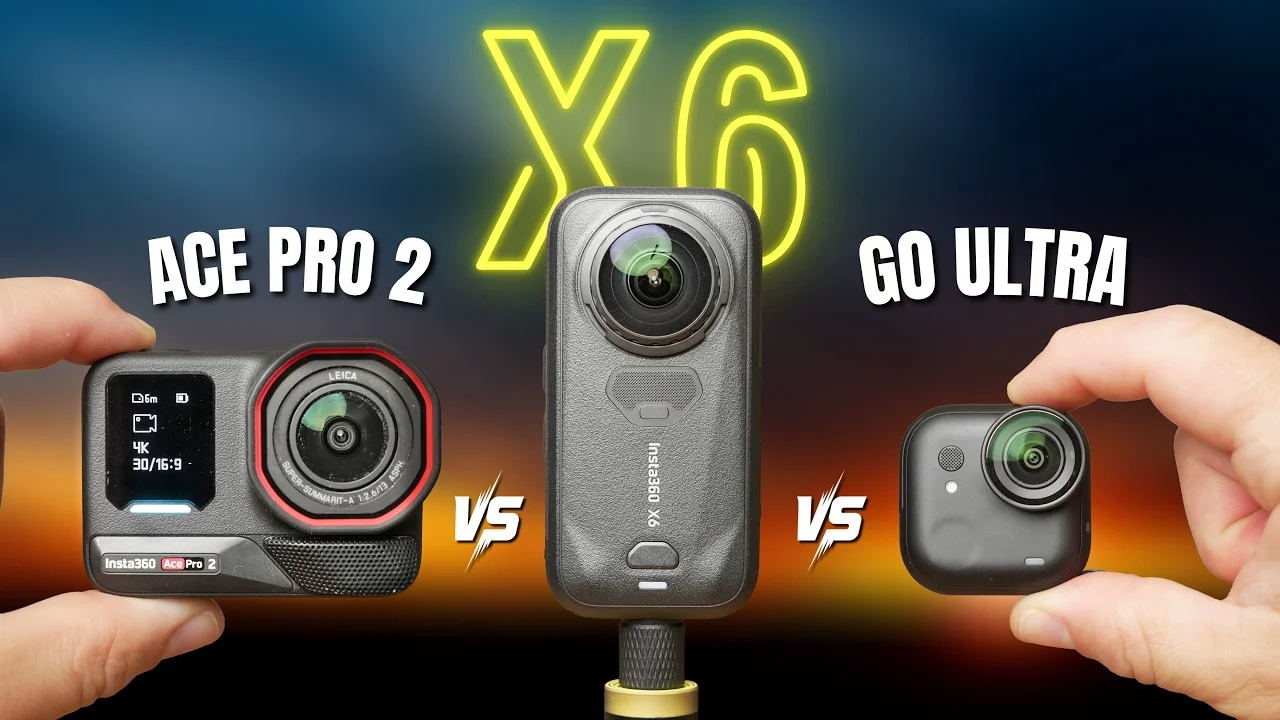
Creator: MountMedia · Published: 2026-10-06 · Length: 13:11 · Watch on YouTube
Detailed outline
[0:00] Insta360 X6 vs GO Ultra vs Ace Pro 2
- The Insta360 GO Ultra and Ace Pro 2 are back on sale at a heavy discount, so it's a good moment to ask whether a conventional action camera is still worth buying or whether you should go straight for the X6.
- The X6 now has a significantly improved Single Lens mode that behaves like a normal action camera, so the video focuses on long side-by-side clips with special attention to that mode.
- Framing: the X6 "can now do almost anything," but it's expensive, and some use cases still favor the GO Ultra or even the Ace Pro 2. The host promises a final pick and current deals at the end.
[0:55] The 6 advantages of the X6
- Reframing — you don't have to nail framing while recording; choose any framing from the full 360° view in post and export a flat clip. You can export several clips and perspectives from one shot. The downside is that you have to reframe, but the Insta360 apps now have many tools plus AI features that reframe automatically (covered in the host's X6 Zero Editing features video).
- Invisible selfie stick — the stick disappears from the shot automatically as long as it's mounted correctly.
- Creativity — reframing plus the invisible stick enable unusual shots; framing can change dynamically during recording, and a wide range of mounts allows shots the GO Ultra or Ace Pro 2 simply can't get.
- Instaframe mode — set the X6 on a stick (the Throwpod shown) and it tracks you as you move freely; the result is an already-reframed flat clip with no editing. Neither rival can do this.
- Stabilization — often underestimated; no conventional action camera keeps up however much you shake it. Even with the GO Ultra's stabilization set to High, it can't compete, largely thanks to the X6's very wide field of view.
- Extremely wide field of view — even at default settings the X6 is clearly wider than the widest setting on either rival, great for action or putting yourself in a landscape.
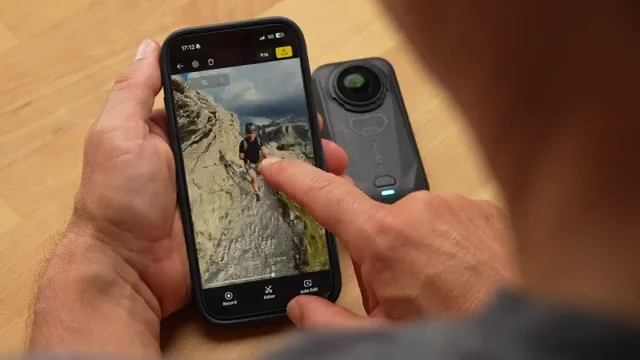
Reframing an X6 360 clip on a phone in the Insta360 app, with the X6 beside it.
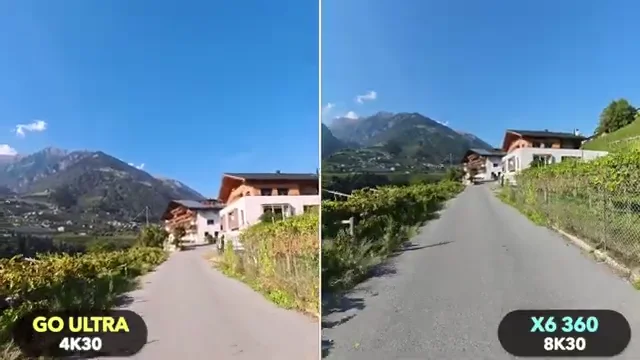
Stabilization test: GO Ultra (4K30, stabilization on High) next to the X6 in 360 mode (8K30).
[3:38] Image quality comparison
- The ultra-wide view brings distortion, and many people prefer a slightly longer focal length. The GO Ultra and Ace Pro 2 offer a Linear setting (less distortion, narrower view) and a 2x lossless zoom (a 2x crop with minimal quality loss).
- You can zoom while reframing X6 footage, but reframing is just cropping a 360 shot, so heavy zoom isn't recommended. The X6 records in 8K, but a reframed flat export is roughly 2.7K effective; the host says the difference is barely noticeable and the reframed shots look sharp.
- Sensors: X6 1/1.1 in (largest), Ace Pro 2 1/1.3 in, GO Ultra 1/1.28 in.
- Color: the X6 finds white balance a bit better in tough scenes like the mountains; the Ace Pro 2 has a strong magenta cast, which the host ties to its Leica co-development. He doesn't always prefer the X6's colors, though.
- The biggest difference remains field of view: choosing any 360 camera means choosing a very wide look.
- Frame-rate drawback: in 360 mode the X6 maxes out at 8K/50; slow motion needs 4K at up to 100 fps, and that still has to be reframed, which lowers resolution further.
[6:13] Low light comparison
- The X6 performs impressively and is in no way inferior; under artificial light its excellent white balance stands out and sometimes gives by far the best footage.
- The GO Ultra and Ace Pro 2 also do well for such poor light. In a very dark scene all three perform about the same, with only minor differences even between the GO Ultra and the Ace Pro 2.
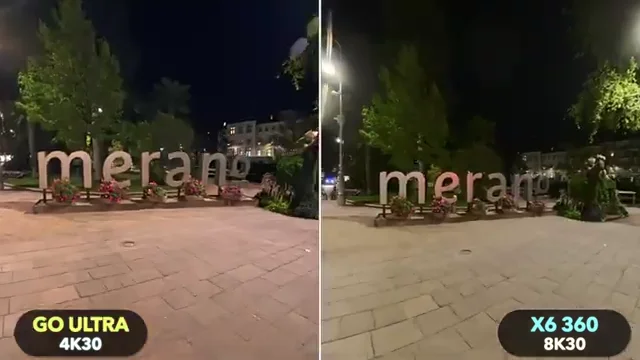
Night test at the Meran sign: GO Ultra (4K30) vs X6 in 360 mode (8K30).
[7:01] Image quality in Single Lens mode
- Key question: can the X6 replace a modern action camera even in Single Lens mode? In this mode it records with one lens, needs no reframing, and works much like the GO Ultra or Ace Pro 2.
- Versus the X5, Single Lens mode on the X6 is heavily revamped: the field of view is freely adjustable and distortion can be reduced.
- Problem: footage often looks too bright and slightly overexposed, and there's no HDR mode in Single Lens (both rivals have a toggleable HDR). Highlights blow out in tough light versus both rivals, so lower exposure a bit and avoid high-dynamic-range scenes.
- Slow motion: the X6 does 4K at up to 120 fps in Single Lens, unusual for a 360 camera and on par with the Ace Pro 2. The GO Ultra only does 120 fps at 2.7K, one of its few weaknesses against the Ace Pro 2.
- Resolution: Single Lens can shoot 4K or 5K; the host thinks 5K generally looks a bit better. The Ace Pro 2 can shoot 8K but only up to 30 fps.
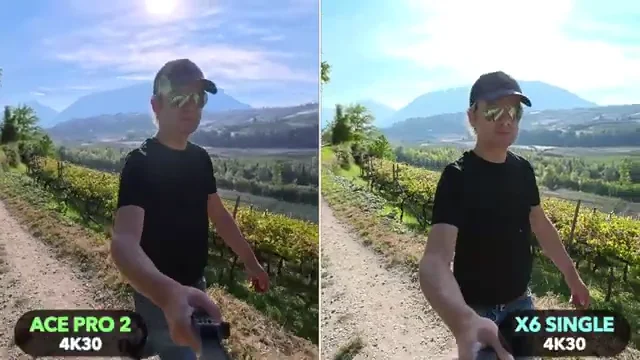
Ace Pro 2 (4K30) next to the X6 in Single Lens mode (4K30), where the X6 tends to run bright.
[8:45] Low light in Single Lens mode
- The X6 holds its own and arguably takes the best shots of the three, thanks to the large sensor.
- Verdict: the X6 can replace a conventional action camera in many ways, but it still lacks dynamic range in Single Lens mode, so GO Ultra and Ace Pro 2 shots often look better. Insta360 should fix the exposure in a future update.
[9:23] Strengths of the GO Ultra
- By far the smallest and lightest camera here: just over 50 g, about a quarter of the X6's weight, with a magnetic back that sticks to metal without a mount.
- The Actionpod is a charging station with a flip-up display that also works as a remote control, so you can operate the camera from a distance while checking framing.
- A recent update added a voice assistant that answers questions, takes a photo and analyzes it, or translates.
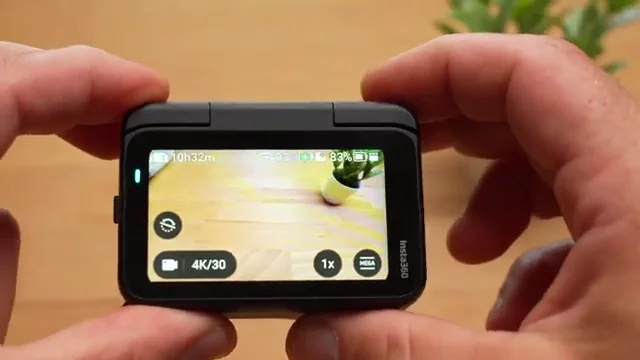
The GO Ultra's Actionpod used as a handheld remote with a live preview.
[10:28] Strengths of the Ace Pro 2
- The only camera here that films 8K without reframing or cropping.
- The only one with Leica color filters.
- The only one that turns into a point-and-shoot with the Explorer Grip, which even connects to a portable printer.
- Underwater: there's a high-quality dive case for the X6 and an Aqua Lens for the GO Ultra, but the Ace Pro 2 is probably still the best and easiest choice. The GO Ultra's Actionpod isn't waterproof, though the GO Ultra and X6 can still get good underwater shots.
[11:16] Prices and special offers
- X6: $700 in the U.S. or 700 EUR in Europe; the description link adds a free Double Lens Kit and 500 GB cloud storage for a year.
- GO Ultra: currently $380, with a free 2-in-1 mini tripod and quick-release mount.
- Ace Pro 2: from $310, with a free mini tripod and water bottle.
- The GO Ultra and Ace Pro 2 also include 200 GB cloud storage for a year. Other Insta360 gear is on sale too, and the free gifts come only through the description links.
[12:08] Which should you buy?
- X6 for action, sports, and nature, where the wide view and invisible selfie stick are a huge advantage. Reframing is no longer a big drawback for the host; it's much easier, the app has plenty of automatic options, and he enjoys the creative side.
- GO Ultra is the best alternative if you aren't interested in 360 shots. Its image quality beats the X6's Single Lens mode, and the compact body plus Actionpod make for an excellent design.
- Ace Pro 2 only if underwater shots are the priority or you want the XPlorer Grip, though the $310 price is appealing.
- CTA: like the video; detailed tutorials on all three cameras are on the channel, with more coming.
Things mentioned
Cameras & hardware
- Insta360 X6 — 360 camera; 1/1.1 in sensors; 8K/50 max in 360, 4K/100 slow motion; Single Lens 4K/120 and 5K
- Insta360 GO Ultra — tiny action camera; 1/1.28 in sensor; just over 50 g; magnetic back; 2.7K/120 slow motion max
- Insta360 Ace Pro 2 — action camera co-developed with Leica; 1/1.3 in sensor; 8K/30; 4K/120
- Insta360 X5 — previous generation, used as the baseline for the revamped Single Lens mode
- Insta360 Flow 2 Pro — phone gimbal, listed in the description deals only
Accessories
- Selfie stick (invisible in 360 footage) and various X6 mounts
- Throwpod — stick/tripod used for the Instaframe tracking demo
- Actionpod — GO Ultra charging case, flip-up display, and remote
- Explorer (XPlorer) Grip — Ace Pro 2 point-and-shoot grip, plus a connectable portable printer
- X6 dive case and GO Ultra Aqua Lens for underwater
- Double Lens Kit — free X6 gift via affiliate link
- 2-in-1 mini tripod, quick-release mount, mini tripod, water bottle — rival bundle gifts
Software, modes & features
- Reframing from 360 into flat clips; multiple exports from one shot
- AI auto-reframing and the X6 Zero Editing features (separate MountMedia video)
- Invisible selfie stick effect
- Instaframe mode — subject tracking with an already-reframed flat output
- Stabilization (GO Ultra tested on High)
- Single Lens mode — adjustable FOV, distortion reduction, no HDR, tends to overexpose
- Linear lens setting and 2x lossless zoom (GO Ultra and Ace Pro 2)
- HDR mode (GO Ultra and Ace Pro 2 only)
- Leica color filters (Ace Pro 2)
- GO Ultra voice assistant — Q&A, photo analysis, translation
- Effective ~2.7K resolution after reframing 8K 360 footage
Prices & purchase options (at upload)
- X6: $700 / 700 EUR, plus free Double Lens Kit and 500 GB cloud for 1 year via link
- GO Ultra: $380 (description: 16% off), plus tripod, mount, and 200 GB cloud
- Ace Pro 2: from $310 (description: 16% off), plus tripod, bottle, and 200 GB cloud
- X5: 15% off, plus Lens Kit and 200 GB cloud (description)
- Flow 2 Pro: 21% off, plus free accessories (description)
- Musicbed affiliate (14-day free trial)
Test locations shown
- Mountain trails and vineyards; night scene at the Meran sign
Biographies
MountMedia (channel)
Tech and action-camera YouTube channel (@MountMediaChannel) focused on Insta360 and competing 360 and action cameras, with settings guides, comparisons, and feature explainers. This upload is a buying guide pitting the X6 against Insta360's own conventional action cameras, with affiliate deal links throughout.
Host (on-camera)
Unnamed on-camera presenter for MountMedia; shoots the side-by-side tests himself in mountain, vineyard, and night-town settings, demonstrates reframing, Instaframe, and the GO Ultra Actionpod, and gives a personal buying recommendation. Contact listed as MountMedia.Studio@gmail.com; socials on YouTube, Instagram (@mountmedia_channel), and TikTok (@mountmedia_channel).
Insta360
Maker of all three cameras compared (X6, GO Ultra, Ace Pro 2) plus the X5, the Flow 2 Pro gimbal, and the Insta360 app with its AI reframing tools. The Ace Pro 2 line is co-developed with Leica.
Leica
German camera and optics company that co-developed the Ace Pro 2; the host links the Ace Pro 2's magenta color cast to Leica's typical look and notes Ace Pro 2–exclusive Leica color filters.